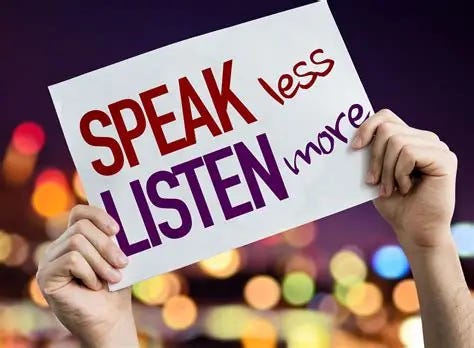
Listening Skills
We can all do better

Back in Uni, I trained as a peer counselor. By far the biggest part of the training was on listening (active listening). It was hugely impactful for me and was probably the biggest thing I took away from school. No class or major ever changed me as profoundly as that volunteer work and the cultivation of listening.
I’m an introvert, so naturally set up to be the receiver. But keeping focus and actively processing what I’m hearing still requires that I do things I am not always inclined to do.
Put down the device. Stop looking at a screen.
Stop planning the rest of the day, the week.
I have a touch of ADHD, so sometimes I will need a fidget. Or to pace (if on the phone). I sometimes have to restrain my brain from flipping into “GO” mode. Learning to “read the room” and know what is being asked of you is also a skill that has to be cultivated (at least for me).
Someone recently mentioned to me that men are terrible listeners. This is the sort of lazy, broad generalization that a literalist like me can hardly ignore. BUT! There is a kernel of real truth there. Many, if not most, men are not great listeners. But the reasons vary so broadly that I don’t think it’s particularly useful.
Here is what I’ve learned over the years. Not that I am always a great listener. But at least I now recognize the ways I (and perhaps all of us) sometimes fail to listen. And how we can do better.
Patience. Real listening is going to take your time. That is biggest gift you are giving. Understand when someone you care about needs your time and accept that.
Attention. Real listening means focusing in a way that our modern multi-tasking, multi-input lifestyles does not encourage. This is the second biggest gift you are giving.
Confirmation. Check that you are actually hearing what is being communicated. It’s shocking how often you can hear the literal words and take away the wrong meaning. Check in.
Restraint. 90% of the time you are not being asked to solve their issue. This is what trips up a lot of men because we are programmed to fix things. This is my daily struggle because 90% of my day is about fixing things. It’s easy to miss the 10%.
If you’re the one talking, needing a listener, there a couple of things you can do to set both of you up for a richer interaction. First, make sure your listener knows that this will take time and ask for it. Sometimes the listener really doesn’t have the time to give at that moment (have to get the kids, for example). Second, set expectations. Do you just need to vent? Need feedback? Want helps solving a problem? Third, choose your audience wisely. Need to vent about emotional drama at work. That might not be for your partner, but for that friend who gets it.
That said, listening, really listening, is an increasingly rare gift you can offer. You might be shocked to see how seldom it is actually done.